
The Great Inversion – How Agentic AI Is Rewiring the Network
Network telemetry / 2026 ■ Human ■ Machine
Machine traffic has overtaken human traffic for the first time — and the optical infrastructure powering it is being rebuilt around CPUs, coordination, and machine-to-machine flows.
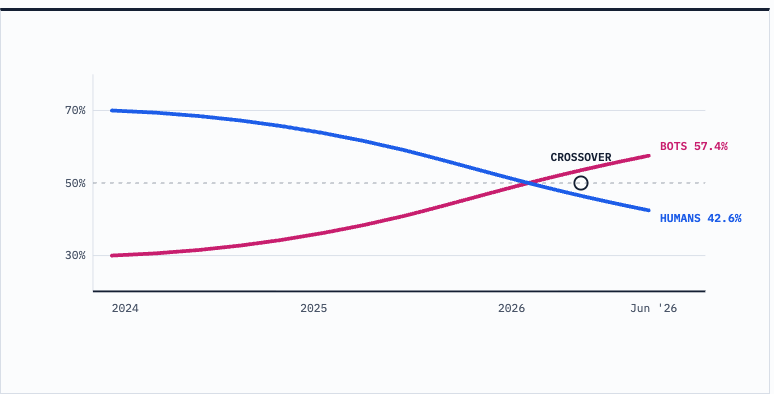
On June 3, 2026, Cloudflare CEO Matthew Prince posted an admission that doubled as a milestone: automated traffic had passed human traffic on the web for the first time.
His own forecast had put the crossover at the end of 2027. It arrived roughly eighteen months early, with Cloudflare Radar showing about 57.4% of web requests coming from bots and agents against 42.6% from people.
HUMAN Security’s analysis of more than a quadrillion interactions found the cause hiding in plain sight: automated traffic grew about eight times faster than human traffic through 2025, and traffic from AI agents and agentic browsers rose nearly 8,000% year over year.
This is not the old bot story of crawlers and spam. The new majority is agentic — software acting on behalf of people, and increasingly on behalf of other software. A human comparison-shops across five websites; an agent may touch five thousand. The internet was architected around human attention: bursty, downstream-heavy, paced by reading speed.
That assumption just expired.
01 / Traffic anatomy
What one agent does to a network
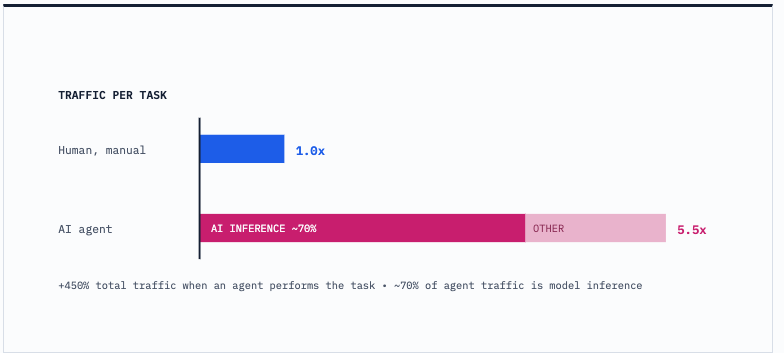
Cisco’s 2026 report, AI Impact on Wide Area Networks, put empirical numbers on what an agent actually costs a network. Running a deep-research-style agent against the same task performed manually by a person, Cisco measured roughly 450% more total traffic per task — about 5.5x. Around 70% of that agent-generated traffic is AI inference: the constant back-and-forth between the agent’s logic and the large language models it consults. Cisco calls this path the agent’s “spinal cord,” because any degradation along it directly impairs the agent’s ability to act at all. Inference traffic, in other words, is graduating from ordinary application traffic to mission-critical infrastructure.
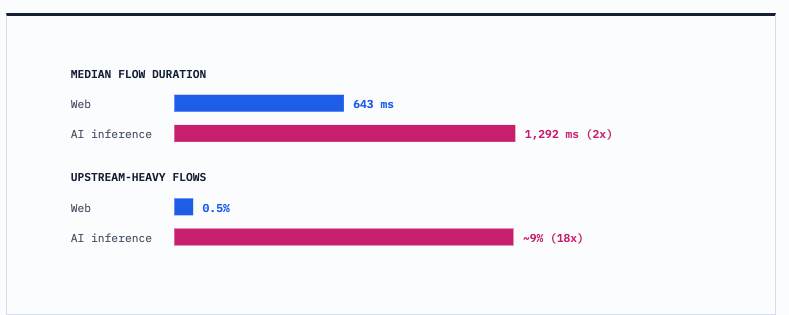
The shape of the traffic changes as much as its volume. Cisco’s measurements show AI inference flows lasting roughly twice as long as typical web transactions — a median of about 1,292 milliseconds versus 643 for ordinary web traffic — because models stream tokens over held connections. Symmetry inverts, too: about 9% of AI inference flows carry more upstream than downstream data, versus roughly 0.5% of typical web traffic, as agents push large, context-rich prompts up the wire. Token consumption in some of Cisco’s datasets grew nearly 10x year over year, with one service-provider measurement showing 4x growth in just eight months.
02 / The decade curve
From 2.5x to 9x
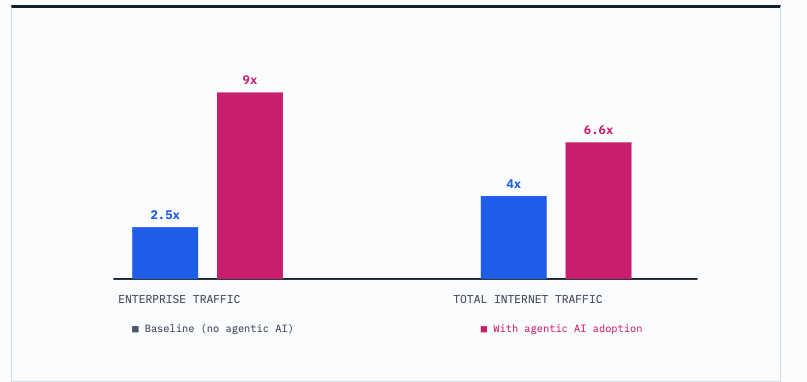
Compound those per-task multipliers across an economy and the projections bend sharply. Cisco’s baseline scenario has enterprise network traffic growing about 2.5x between 2026 and 2035 on ordinary digital-transformation momentum. With widespread agentic adoption, that becomes roughly 9x. Data centers become the center of this transition and Data Center Interconnection via optical network the critical linkage.
Overall internet traffic follows the same pattern at lower amplitude: about 4x growth by 2035 without AI’s impact, 6.6x with it — a 63% increase above baseline. By 2035, Cisco projects AI inference alone could represent a quarter of all network traffic, with the steepest climb between 2029 and 2032, when inference traffic growth rates approach 25% annually and agentic adoption is expected to hit its stride.
The mechanism behind the curve is fan-out. A single human intention — book the trip, source the component, reconcile the invoices — decomposes into an agent’s plan, and each step of that plan generates its own web of calls: model inference, retrieval queries, API requests, verification passes, retries. Where a person’s task produced one bursty session, an agent’s task produces a sustained mesh of machine-to-machine conversations. And unlike human demand, which is bounded by population and waking hours, agentic demand is bounded only by the economic value of running one more agent. That is why the ratio between human-originated and machine-originated traffic doesn’t merely drift — it inverts, and keeps going.
One human request no longer maps to one network conversation. It fans out into hundreds or thousands of machine-to-machine calls — research, comparison, negotiation, transaction — executed at software speed.
03 / The silicon rebalance
The CPU renaissance
The chat-LLM era was a GPU story: a human types a prompt, a cluster of accelerators performs a burst of parallel matrix math, an answer streams back. Agents break that pattern. An agentic loop — plan, act, reflect, revise — is sequential and branchy. The model call is one step; the surrounding work of parsing, planning, tool execution, retrieval, memory management, retries, and coordination between agents is CPU work. Morgan Stanley’s framework finds CPU-side orchestration accounting for 50–90% of total workload latency in agentic systems, and academic profiling of agent pipelines has measured tool execution dominating latency and a large share of dynamic energy consumption. The GPU still supplies the intelligence; the CPU increasingly runs the agent.
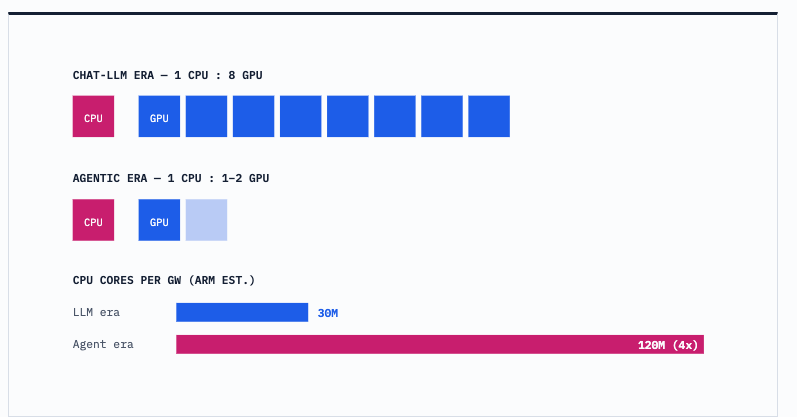
The hardware market has responded with unusual speed. Traditional AI servers ran roughly one CPU per four to eight GPUs; TrendForce projects agentic deployments landing between 1:1 and 1:2, and Intel’s leadership has said the mix could reach parity or tilt beyond it. Arm estimates that AI data centers needed about 30 million CPU cores per gigawatt in the LLM era and will need roughly 120 million in the agent era — a fourfold structural jump. Morgan Stanley sizes the prize at $32.5–60 billion of incremental CPU market by 2030, inside an orchestration-CPU data-center market of $82.5–110 billion, alongside 15–45 exabytes of additional DRAM demand. The signals are visible on the ground: Intel and AMD raised server CPU prices amid supply shortages, and in March 2026 NVIDIA introduced its first standalone Vera CPU rack while Arm entered the market with dedicated CPU racks aimed explicitly at agentic infrastructure.
None of this dethrones the GPU — it reframes it. Accelerators remain unbeatable at the parallel matrix math that constitutes intelligence itself, but in an agentic loop they sit idle while the CPU parses, calls tools, and waits on external systems, which is precisely why operators are disaggregating CPU and GPU into separate racks that can each run at high utilization. The economic center of gravity widens from raw compute to the full stack of coordination: general-purpose cores, persistent memory holding agent context, and the interconnects binding them together.
04 / First-order infrastructure
The network stops being plumbing
The deepest change is conceptual. For thirty years, networks were designed as plumbing for human attention: optimize downstream video, cache the popular content close to eyeballs, tolerate latency people wouldn’t notice. Agentic AI makes optical networks a first-order component of the compute system itself.
When 70% of an agent’s traffic is inference calls, and agents chain to tools, data stores, and other agents across clouds and edges, throughput and reliability on those paths determine whether work gets done at all. Cisco notes that inference processing time still dwarfs transport latency today — hundreds of milliseconds of model time versus 20–50 milliseconds of network time — but as inference hardware accelerates, network latency becomes the binding constraint, pushing inference toward the edge and making interconnection density and path optimization strategic assets rather than operational details.
That reframing cascades through architecture. East-west and machine-to-machine flows grow relative to the north-south, human-facing patterns networks were tuned for. Steady, persistent M2M load replaces bursty human diurnal rhythms, changing capacity planning and QoS design. Observability must distinguish a legitimate agent from a malicious one — a problem sharpened by the fact that the two are often behaviorally identical. Identity, authentication, and rate-limiting for machines become as central as they once were for people, and content itself is being reformatted for machine consumption. Interconnection providers, Ethernet fabrics, and edge inference placement all rise in strategic importance because agent speed is bounded by the slowest hop in the chain.
05 / Conclusion
Designing for the machine majority
Every era of the internet encoded an assumption about who it was for. The dial-up web assumed a reader; broadband assumed a viewer; mobile assumed a person in motion. The agentic internet assumes, for the first time, that the primary user is not a person at all. The evidence has moved from projection to measurement: bots already outnumber humans on the wire, agents multiply traffic per task more than fivefold, and the silicon roadmap has swung back toward the general-purpose processors that coordinate rather than merely calculate.
The chat era taught the industry to scale GPUs. The agentic era is teaching it to scale everything around them — CPUs, memory, interconnects, and above all the optical network, which has quietly become the nervous system of the machine economy operating at light speed. The organizations that internalize this inversion early, treating inference paths as critical infrastructure and planning for machine-majority traffic, will be the ones whose agents actually work when it matters.
Sources. Cisco, AI Impact on Wide Area Networks: 2026 Report (traffic multipliers, flow characteristics, 2026–2035 projections) • Cloudflare Radar / Matthew Prince, June 3, 2026 (bot–human crossover) • HUMAN Security, 2026 State of AI Traffic & Cyberthreat Benchmark Report (8x automated growth; ~7,851% agentic growth) • Morgan Stanley, April 2026 (agentic CPU TAM, orchestration latency, DRAM demand) • TrendForce & Arm (CPU:GPU ratios; cores per GW) • Intel Q1 2026 earnings call • NVIDIA GTC March 2026 (Vera CPU rack). Charts are stylized renderings of reported figures; Fig. 1 trend interpolated between reported data points.
